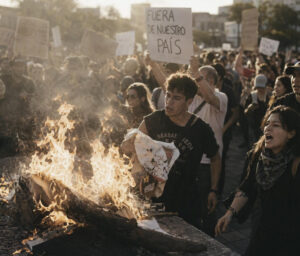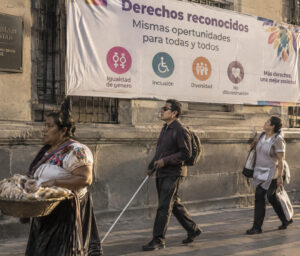

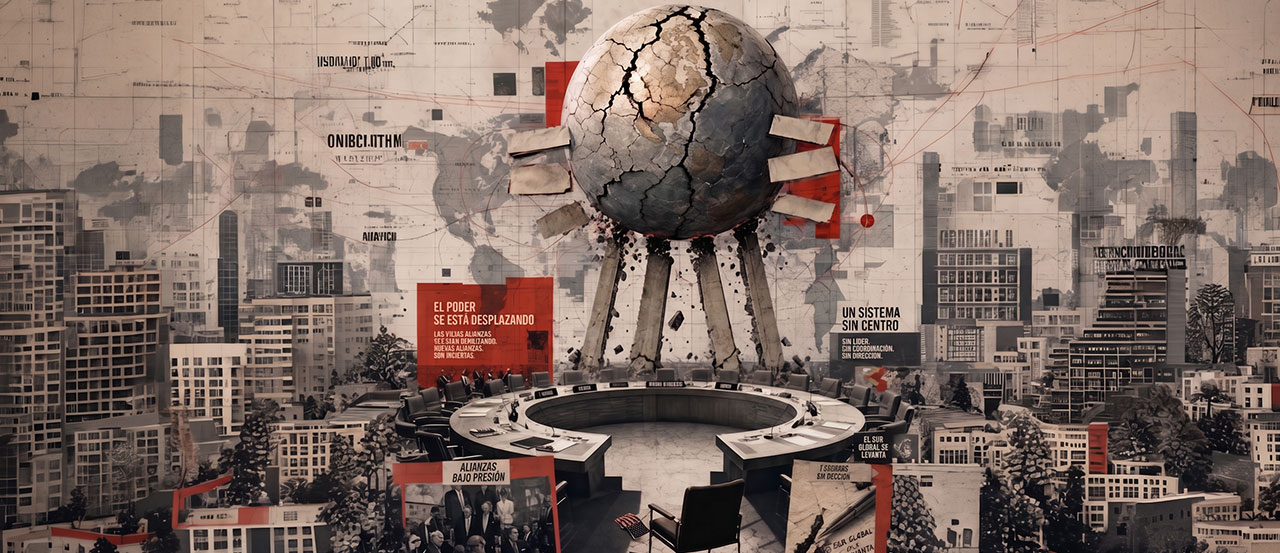
Fuente: Imagen creada con IA.

Año 1, núm. 11, junio de 2026
ISSN 3122-3583
a fondo
Rupture and its Lack of Ideology
Toby Mendel *
El mundo no atraviesa una transición: vive una ruptura. En este texto se analiza el retiro de Estados Unidos del orden internacional basado en reglas y se advierte que el problema no se agota en Trump: responde a una transformación estructural que deja al multilateralismo sin su principal garante.
El orden internacional basado en reglas siempre fue imperfecto, pero ofrecía estabilidad suficiente para que las potencias medias pudieran prosperar.
On 20 January 2026, Mark Carney, Prime Minister of Canada, gave a ground-breaking speech at the Davos World Economic Forum. Rumours abound as to the popularity of the speech, but I was told by a tech expert from the Arab World in late January that it had already been shared 200 million times in that region, which hosts less than 500 million people. The speech was rich in content and ideas, but undoubtedly one of the most important references was the notion that the world is “in the midst of a rupture, not a transition”. As to the nature of the rupture, according to Carney, it was the demise of the so-called “rules-based international order”.
Carney was careful to note that the idea of an international rules-based order was always partially false, and that “great powers” would sometimes abuse the rules. But international law did at least create enough stability and predictability for “middle powers”, like Canada, to feel safe and to prosper.
What Carney did not state explicitly, but what is certainly true, is that from among the various candidates for great power status, only the US, despite its frequent failings, really backstopped the rules-based international order. Even while it sometimes abused them, the US ensured broad enforcement of trade rules. In his Davos speech, Carney referred to the role of the US in maintaining “a stable financial system” and “support for frameworks for resolving disputes”. And, arguably, no other country could do this. Think, for example, just of the role of the US dollar in international financial matters: as the dominant currency in which central banks hold their reserves, as the primary medium of exchange for trade among countries, and as the primary currency for denominating debt.
The US also generally acted as global policeman, whether through its leadership of the North Atlantic Treaty Organization (NATO), its watchful eye over the Korean Peninsula or its significant engagement in the Middle East. While it certainly also abused the rules on the use of force — perhaps most blatantly and destructively in modern times in the case of the 2003 invasion of Iraq — the impact of the US as a force for peace, and for containing would-be aggressors around the world, cannot be denied.
Indeed, while it has often been fashionable to focus on the undoubtedly many abuses perpetrated by the US, there are those who argue that it has represented, perhaps for the first time ever in history, a relatively benevolent superpower or hegemon (1).
That has now clearly changed. Perhaps the clearest manifestation of this is the significant retreat of the US from intergovernmental organisations (IGOs). The US is withdrawing entirely from 31 United Nations (UN)-affiliated organisations — including the World Health Organization (WHO) and UNESCO — along with some 35 other IGOs. And its commitment to many more organisations has faltered. It has stepped back considerably from NATO: earlier this year it scrapped the deployment of a Long-Range Fires Battalion (LRFB), equipped with hypersonic missiles, to Germany. These measures have immediate and direct financial consequences for the IGOs concerned, but they are likely more significant in their impact on the credibility and operational effectiveness of those organisations.
La retirada de Estados Unidos de organismos internacionales debilita no solo su financiamiento, sino su credibilidad y capacidad operativa.
Not only has the US stopped backstopping the international rules-based order, it has started to engage in an unprecedented level of breach of those rules. The world has often witnessed US breaches, sometimes serious, but their rate and severity have increased dramatically under the current Trump administration. The most widespread actions are the various tariffs imposed on most of the world, many of which have been held to breach World Trade Organization (WTO) rules. But the most extreme actions are undoubtedly the clearly illegal abduction of the President of Venezuela, Nicolás Maduro, and his wife, Cilia Flores, and the equally illegal war against Iran, currently ongoing, with massive implications for every country in the world.
Although many will associate these changes with the Trump administration — and in particular with the return of Donald Trump to the presidency in 2025 — their drivers are essentially non-ideological and much deeper than one leader. They are grounded in a new radically internal focus on the part of Americans, a willingness to achieve economic growth regardless of the consequences for other countries — even regardless, some would say, of whether the actions in question actually contribute to American growth.
Showcasing the longer-term, non-ideological nature of this, the US has gutted the ability of the WTO to enforce its rules by blocking the appointment of WTO judges. If a country loses a dispute at the lower panel level, it can simply appeal to the next level, creating a legal limbo due to the absence of judges — known as “appealing into the void”. This process started in 2019, during the first Trump presidency, but it continued as a deliberate policy through the Biden presidency.
Thus, while Trump has massively accelerated US withdrawal from the international arena, along with the pace of direct breaches of international law, it would be naïve to expect this to return to the status quo ante after he leaves. We might see some changes and even some improvement but, regardless of who — representing which party — wins the next presidential election, the core structural change will remain.
La ruptura actual no es puramente ideológica: expresa un giro interno de Estados Unidos hacia sus propios intereses, incluso a costa del sistema global.
The direct impact on others of US breaches of international law is fairly obvious, whether that be the cost of illegal tariffs for business, the increased price of oil globally due to the war in Iran or, for all too many countries in the Middle East, the direct military impact of that war.
The impact of the US no longer playing a key role in supporting the enforcement of international law is far less clear. One of the reasons Carney’s Davos speech was so popular was because he explicitly identified this phenomenon for the first time at that level. Once rogue leaders around the world start to factor this into their decision-making, who knows how they may decide to take advantage of the new “room to manoeuvre” they have effectively been allocated. The chaotic, unpredictable nature of Trump as President may actually offer some cover here, if those same rogue leaders are temporarily cowed out of fear of provoking him. Should the global leadership gap settle under a more stable president, the consequences would be impossible to predict. One risk, however, is increasingly lawless behaviour being manifested by a greater number of States than ever before.
It would be remiss not to mention the role of China in this discussion. Under Xi Jinping’s rule since 2012, China has become more aggressive militarily, economically and in terms of exporting its anti-democratic values. This is reflected, for example, in the large number of workshops held in China for journalists and editors from Global South countries which promote the “positive news” doctrine — news as supporting national development rather than providing independent, critical information to people — and dismiss press freedom and related ideas as Western, neo-colonial notions. But these developments, while unfortunate, hardly represent a rupture of any sort, let alone to the international rules-based order.
On the other side of the coin, China has a lot to lose from the decline of the international rules-based order. However, it is hard to imagine China being able to step up to replace, even partially, the gap left by the US. And, to date, we have not seen any real sign of that.
The focus of this piece is on international rupture, but it is worth noting that respect for the rule of law and democracy have also suffered internally in both the US and China. The US is facing a frontal attack on the rule of law: militarisation and politicisation of civilian law enforcement, State political harassment of private companies and universities, abuse of State resources for political ends and forceful attempts to undermine freedom of expression — and all of this in the country which once prided itself as the leader of the free world. Tolerance of dissent and open debate has also declined significantly in China under Xi Jinping. And respect for democracy and human rights have also plummeted in Russia since the start of its brutal, ongoing and utterly unwarranted full-scale invasion of Ukraine in February 2022.
If China cannot be expected to address the US rupture, can something else be done to prevent or at least delay the decline of the rules-based international order? A key thrust of Carney’s solution was what he called “variable geometry” — building “different coalitions for different issues, based on common values and interests”. Perhaps in the circumstances that is the best that can be done. And the European response in the context of NATO, with very significant increases in European defence spending now in play, may showcase the potential of this approach.
But there are also severe limitations on what can be achieved this way. This approach will not save the many international institutions which are now under threat. And, although solidarity in the face of US threats to Greenland seems to have paid off, it will often be difficult to contain breaches by the US and others via this strategy. As an example, despite relatively strong international solidarity following the brutal military coup in Myanmar in February 2021, support from a small number of other States — most obviously China and Russia — has allowed the regime to survive. In addition, loose coalitions of this sort are viable, even medium-term, only in the context of strongly unifying interests and values. While Trump’s highly aggressive tactics have managed to ignite the sort of unified opposition which helps create coalitions, more subtle — if no less self-interested — future US leadership might be less conducive to this. And, even when interests and values are strongly unified, a collective stand often remains elusive, as in the case of US tariffs, where we have seen many very short-term, selfish reactions by countries — that is, by trying to curry favour with the US administration rather than by acting in a coordinated, principled manner.
There is no question that the style of the current US administration is heavily influenced by its leader, and that this style is likely to change — probably dramatically — under a future president. But it is far less likely that the rupture Carney talked about will come to an end: its essence is a significant stepping away by the US from backstopping the rules-based international order, and as suggested above, these changes are not ideological in nature but have deeper social, political and even cultural roots. No doubt some of the rough edges of the Trump administration will be smoothed over, but we should expect the US to continue to focus heavily on its own interests, to the detriment of the rules. Let’s hope Carney’s appeal to coalitions has some power to parry the worst impact of this change. But the near future seems likely to be a period of chaos and instability.
* Exdirector Ejecutivo del Centre for Law and Democracy.
*** Nota de la redacción: este texto se publica en inglés, lengua nativa del autor, en consonancia con la vocación internacional de El Diluvio.
References
(1) Kagan, R. (1998). “Benevolent Empire”. Carnegie Endowment for International Peace. https://carnegieendowment.org/posts/1998/05/benevolent-empire